
Your cart is empty now.
Your search for "gods emissaries." revealed the following:

This book is a poignant compilation of reflections and narratives from the life of Aḥmad ʿAlī Nayrī, a humble yet impactful figure who dedicated his life to the service of God and his community. This biography chronicles the extraordinary journey of a young man who navigated the complexities of contemporary life while embodying the virtues of faith, sincerity, and sacrifice. Through the voices of his family and friends, readers are invited to witness Aḥmad’s spiritual evolution and his ultimate sacrifice as he answered the call of martyrdom, leaving a lasting legacy of devotion and moral integrity.
Specifications:
~184 pages
BW pages
5.5x8.5 in
The second volume of the English translation covers verses 94–182 of Sūrah al-Baqarah (Chapter 2), addressing theological, philosophical, and ethical themes. The volume explores divine covenants, the rejection of messengers, the principle of Imāmah, and the soul’s journey. Notable sections include the Jews’ claims of exclusivity in salvation (verses 94–99), the story of Hārūt and Mārūt and its moral lessons (verses 102–103), the Kaʿbah’s spiritual significance (verses 125–129), and discussions on the soul’s immateriality and Barzakh (verses 153–157). Ethical topics such as Qiṣāṣ (retaliation) and its role in justice (verses 178–182) are also addressed. ʿAllāmah Ṭabāṭabaʿī provides a comprehensive analysis of verse 2:124, which narrates the bestowal of Imāmah upon Prophet Abraham. He explains how Imāmah transcends the prophetic mission, embodying divine leadership that ensures the continuation of guidance for humanity. The commentary highlights the moral and spiritual qualifications required for Imāmah, emphasizing its relevance as a principle of divine justice and governance.
Volume twenty-five provides an in-depth commentary on Sūrah al-Isrāʾ (Chapter 17), also known as “The Night Journey.” This chapter, consisting of 111 verses, primarily focuses on the glorification of God, the Prophet Muḥammad’s ascension, divine guidance, and human accountability. The chapter opens with the theme of God’s transcendence and His complete freedom from any association with partners. This is emphasized in the declaration of the Prophet Muḥammad’s night journey (isrāʾ) from the Sacred Mosque in Mecca to the Farthest Mosque in Jerusalem. ʿAllāmah Ṭabāṭabaʿī explores the theological and symbolic significance of this journey, highlighting it as a divine honor bestowed upon the Prophet to reveal some of God’s greatest signs. The journey serves as a testament to the Prophet’s unique status and the ultimate truth of his message. The commentary includes an extensive discussion on the rise and fall of nations, particularly focusing on the Israelites. ʿAllāmah reflects on their history as a lesson for all believers, emphasizing the correlation between obedience to divine commands and societal prosperity, as well as the consequences of defiance and corruption. He connects these reflections to the broader principles of divine justice and human responsibility, underscoring the universality of these themes. A key portion of this volume addresses various ethical and social injunctions presented in Sūrah al-Isrāʾ, such as the prohibition of idolatry, maintaining justice, honoring one’s parents, and the sanctity of life. ʿAllāmah examines these principles in depth, linking them to the Qurʾānic vision of a harmonious and righteous society.
A Mystic’s Advice: Spiritual Guidelines by Āyatullāh Bahjat is a distilled window into the inner life, teachings, and spiritual method of one of the greatest contemporary Shīʿī mystics and jurists. Compiled from the preserved words, letters, lectures, and daily practices of Āyatullāh Muḥammad Taqī Bahjat, the work serves as a guide for seekers wishing to journey toward God through the Qurʾān and the teachings of Ahl al-Bayt (ʿa). Though concise, it was intentionally crafted as a teacher manifesting in these pages for anyone striving for nearness to God, containing essential principles that spare the true and earnest seeker the need for another book.
The book opens with a brief biography—his blessed childhood, studies in Karbalāʾ and Najaf, his spiritual training under Sayyid Qāḍī, and his emergence as a model of piety whose humility veiled extraordinary spiritual states and miracles. It outlines the foundations of his mystical school, emphasizing necessary obligations, purified intention, simplicity in living, vigilance, and the exclusive use of spiritual exercises grounded in the Sharīʿah—such as night prayer, monthly fasting, and visitation of the Imāms’ shrines. It also highlights his belief that true wayfaring requires no hidden system beyond the certainties already known to every believer and that one’s “master” may be the very knowledge God has already made clear.
A Mystic’s Advice includes his letters, ethical counsels, practical solutions to spiritual problems, and nearly forty concise maxims. His guidance stresses acting on what one knows, keeping the company of those who remind one of God, avoiding pretension, and calling others to God through deeds rather than words. The result is a work that joins biography, method, and lived wisdom into a reliable path of clarity, sincerity, and God-centered discipline in an age marked by distraction and counterfeit spirituality.
Specifications:
~442 pages
Color Pages
6x9 in
Hardcover with Dust Jacket

The book is a compendium of memorable lectures delivered by the venerated author in 1992 in the Holy city of Qum in Iran. The book offers beauty on the existence of Almighty Allah SWT and his oneness. In doing so, inspiration has been sought from the traditions of the Holy Ahlul Bayt (as). The author also analyses from the perspective of transcendent Wisdom (Hikmatul Muta'alia) arguments that have been put forward for the Divine existence outside the realm of Islamic Intellectual traditions. The book is highly recommended for those who need to have a better understanding of Divinity.
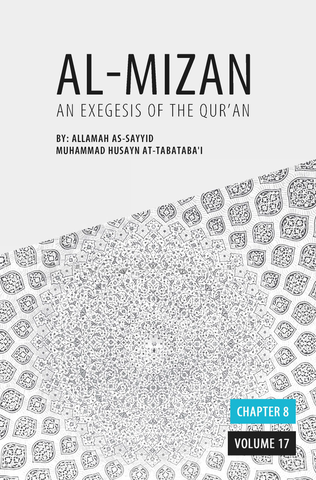
This volume provides an in-depth exegesis of Sūrah al-Anfāl (Chapter 8), which addresses themes of faith, divine justice, and the ethics of conflict. This chapter, often referred to as “Sūrah Badr,” reflects upon the Battle of Badr and derives broader lessons for individual and societal conduct. The commentary begins by discussing the distribution of spoils of war, emphasizing the principles of divine ownership and collective responsibility. ʿAllāmah Ṭabāṭabaʿī highlights the Qurʾānic approach to resolving disputes among believers, advocating for reconciliation and adherence to divine commands. He explains how the rules surrounding anfāl (spoils of war) serve as a mechanism for maintaining social harmony and justice. A significant portion of the chapter focuses on the characteristics of true believers, as described in verses 2–4. ʿAllāmah elaborates on their spiritual traits, including their reverence for God, trust in Him, and dedication to prayer and charity. These qualities, he notes, form the foundation of a cohesive and morally upright community. He also reflects on the concept of īmān (faith) as a dynamic and evolving state, deepened through reflection and adherence to divine guidance. The commentary then transitions to the narrative of the Battle of Badr, which is presented not merely as a historical event but as a manifestation of divine support for the faithful. ʿAllāmah examines the moral and spiritual lessons derived from this victory, including the importance of unity, reliance on God, and perseverance in the face of adversity.

This book is an invitation to a journey, an interior journey of discovery in quest of a lost treasure containing the most precious jewels of the whole of creation. The map which shows the way is to be found in the final message of Allah for mankind, a way which is also indicated by the internal compass in every heart. We begin our journey with an inquiry into the nature of the spirit and its virtues and vices, and we are led to an understanding that man has the potential to be the representative of God on earth. If we pay heed to our origin and present conditions, and if we arrive at a sufficient understanding of our ultimate goal, the kinds of knowledge that are obtained on the journey will help us to make wise choices about the course our lives may take.

This book presents a systematic and comparative study of the intellectual and theological principles that define the Islamic worldview. Āyatullāh Fāḍil al-Ṣaffār examines the concept of divine knowledge and its central foundations: tawḥīd (Divine Unity), ʿadl ilāhī (Divine Justice), nubuwwah (Prophethood), Imāmate, and maʿād (belief in the Hereafter). Through an analytical approach, he explores how Islamic theology harmonizes reason and revelation in understanding God, existence, and moral responsibility. The book concludes with a comparative analysis between Islamic thought and other philosophical and religious systems, showing how Islam integrates intellectual inquiry with revealed truth. Serving as both a methodological and doctrinal study, this work highlights the coherence, depth, and balance of the Islamic system of divine knowledge and its place within the broader human search for truth.
Specifications:
~526 pages
BW pages
6 x 9 in
Hardcover

This book by Āyatullāh Bashīr Ḥusayn al-Najafī is an exploration of repentance in Islāmic teachings. Drawing from the Noble Qurʾān, prophetic traditions, and the wisdom of the Ahl al-Bayt (as), the book delves into the necessity, conditions, and power of sincere repentance. It examines obstacles that prevent one from returning to God and highlights the immense mercy and love that await the repentant. With insightful commentary and scholarly depth, this work serves as a theological guide and a spiritual manual for those seeking divine forgiveness and closeness to God.
Specifications:
~322 pages
B/W pages
5.5 x 8.5 in
Softcover
Translation missing: en.general.search.loading